
I’ve never met Jamie Oliver. Prior to today, reading the transcript of his 2010 TED Talk on Medium, all I knew about him was that he was a celebrity chef.
I’ve seen a couple of his television programs before. He seemed to me like an affable guy who enjoys cooking. Well guess what? I’m an affable guy guy who enjoys cooking too.
In fact, I used to work with a team that prepared 100 organic, vegetarian meals a day for children. Three times a day, seven days a week, we prepared healthy and delicious food (including bread made from scratch). I was proud of my work but I never once considered myself in the business of saving lives:
My name’s Jamie Oliver. I’m 34 years old. I’m from Essex in England and for the last seven years I’ve worked fairly tirelessly to save lives in my own way.
Jamie’s TED talk goes on to talk about the leading causes of death in the United States, using this ancient infographic from 2006:
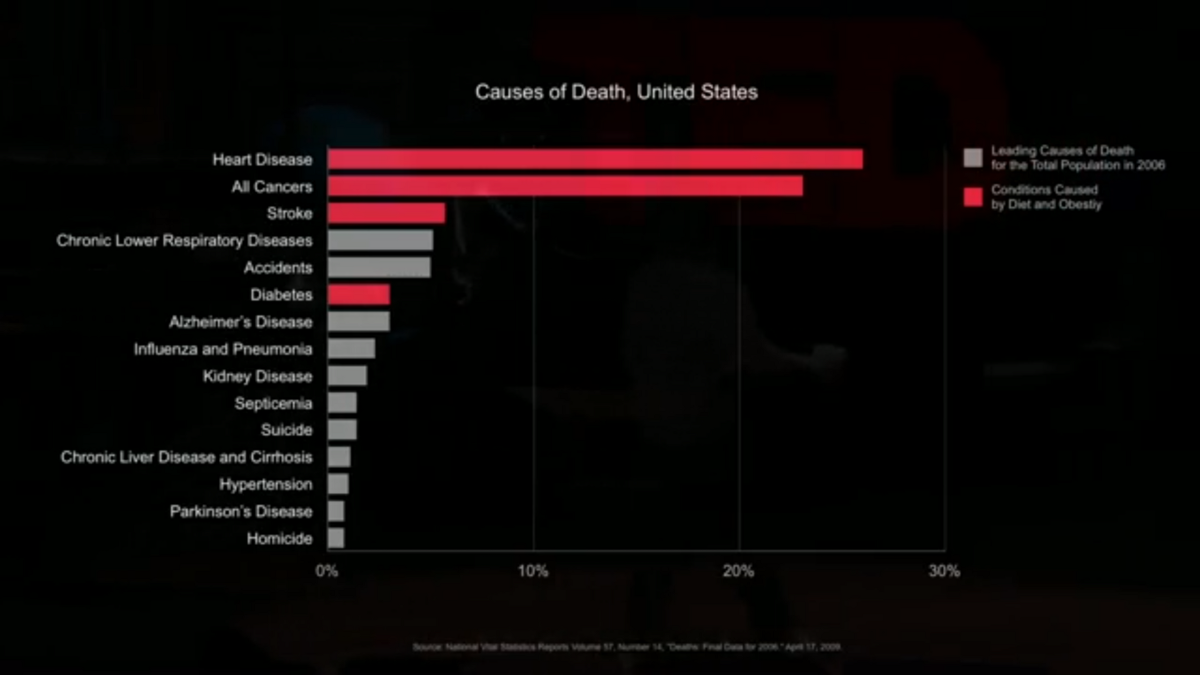
The diseases outlined in red are diet-related, as Jamie helpfully informs us:
Every single one of those in the red is a diet-related disease. Any doctor, any specialist will tell you that.
Fact: Diet-related disease is the biggest killer in the United States, right now, here today. This is a global problem. It’s a catastrophe. It’s sweeping the world. England is right behind you, as usual.
Jamie’s numbers are certainly right. Heart disease, cancer, stroke and diabetes truly are killing millions of people in the United States, Britain and many other countries.
The statistics are right. The conclusion is what’s wrong, because not one of those diseases is “sweeping the world” as a new phenomenon.
I’m no apologist for purveyors of junk food and industrialized chemical “food” pouring out of factories but clearly Jamie is drawing some very unscientific conclusions from the data.
Here’s more from Jamie:
Let’s start with the Main Street. Fast food has taken over the whole country; we know that. The big brands are some of the most important powers, powerful powers, in this country. Supermarkets as well. Big companies. Big companies.
I am American but I live in the Republic of Moldova. It is one of the poorest countries in all of Europe. And I am here to tell you that fast food has not taken over this country.
I live in the wealthiest sector (Buiucani) of the capital, Chisinau. Within a 2km radius of my apartment there are 7 open-air markets (selling fresh vegetables, dairy and fruit), over 20 grocery stores and just 1 fast-food place.
Big companies don’t dominate what people eat in this country. The majority of people in this nation live in the countryside, where they eat domestically-produced (and often grown at home) vegetables, fruits and foodstuffs.
Even here in the capital (which is also the largest city in the country), almost everyone does their shopping at the open-air markets, buying only fresh, unlabeled food that is grown here or in neighboring Ukraine. Processed foods are expensive, as are restaurants, and the majority of meals are eaten at home.
The people in Moldova today embody the concept of eating “largely local, largely fresh” food. Nothing could be healthier, right?
Let’s look at the causes of death in the Republic of Moldova. Statistics are for the year 2013 and come from here (link is in Romanian language). The Moldovan statistics are not categorized in exactly the same way as Jamie’s infographic but I’ve done my best to make them align as much as possible.
| Cause | # deaths | |
| 1 | Heart Disease | 22130 |
| 2 | Stroke | 5931 |
| 3 | Cancer | 5883 |
| 4 | Digestive tract illnesses | 3364 |
| 5 | Trauma and poisoning | 2839 |
| 6 | Hepatitis and Cirrhosis | 2607 |
| 7 | Pulmonary diseases (COPD) | 1711 |
| 8 | Hypertension | 1126 |
| 9 | Suicide | 576 |
| 10 | Other | 550 |
| 11 | Infectious diseases | 437 |
| 12 | Accidents | 396 |
| 13 | Endocrine diseases | 375 |
| 14 | Diabetes | 360 |
| 15 | Nervous system diseases | 291 |
So what does that tell us?
In a country like Moldova, where obesity is rare and where people are eating local, fresh food, the causes of death are nearly the same as in the United States.
Surely this must be a mistake, right?
No.
From here we can see what the leading causes of death were in the United States since 1900:
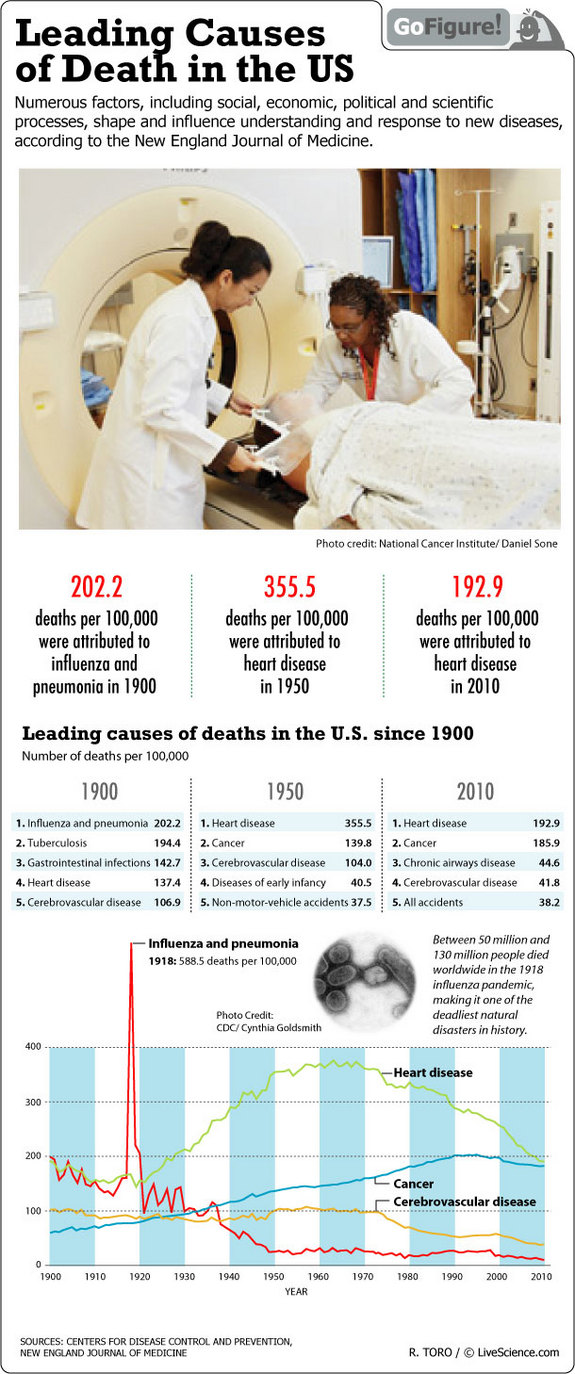
As you can see, the prevalence of heart disease deaths in 1900 is almost identical to 2010. Mind you, in the year 1900, fast-food restaurants and large supermarkets didn’t exist, most people cooked at home and there were no big agrobusinesses shoving microwaved, frozen, processed foods down people’s throats.
McDonald’s didn’t even take off until 1955. So how is it possible that heart disease was still the number one killer of Americans in 1950? And how is it possible that heart disease is the number one killer (by a large margin) in Moldova, where the majority of people still eat fresh, local food cooked at home?
Jamie wants to teach people how to cook seasonal, fresh foods. I support that. I also support his initiatives on teaching children how to recognize (and eat) healthy foods. I wish him all the best in these endeavors.
But first, he has to recognize that he himself is part of the problem.
Back to his TED talk:
The big brands are some of the most important powers, powerful powers, in this country. Supermarkets as well. Big companies. Big companies. Thirty years ago, most of the food was largely local and largely fresh. Now it’s largely processed and full of all sorts of additives, extra ingredients, and you know the rest of the story.
You know who is introducing processed foods to Moldova? That’s right, Jamie Oliver.
Here’s a photo I took today in the largest supermarket in the capital:
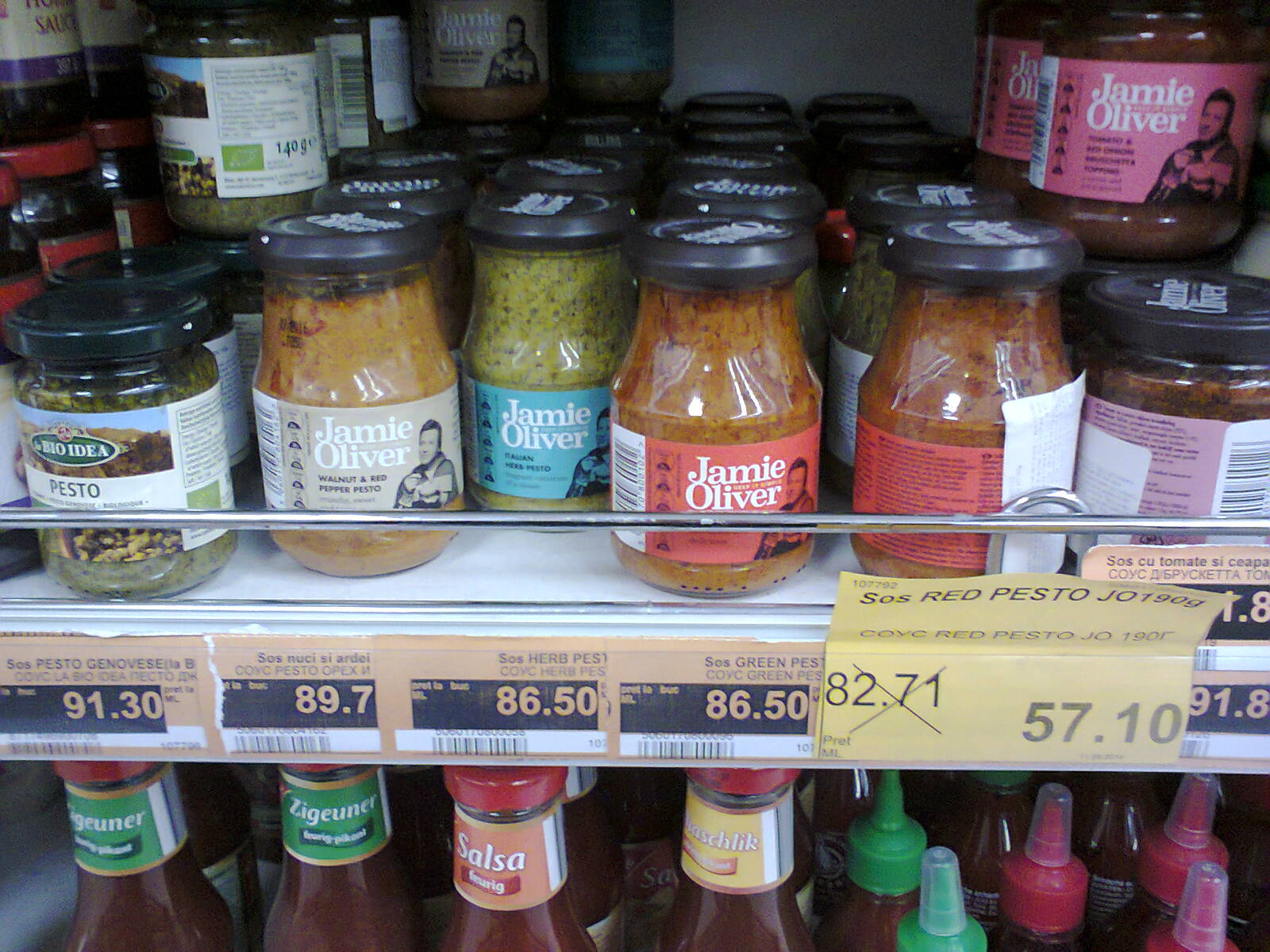
87 Moldovan lei (approximately £3.70) may not seem much to a British shopper, but that’s an entire day’s wage for the average worker in this country, all for a tiny jar (190 grams) of processed food.
That pasta sauce isn’t being cooked by Jamie himself, bottled by friendly elves and then shipped to Moldova. It’s being brewed in gigantic industrial steel vats somewhere in the UK and shipped over here at great expense.
The shop where I found this overpriced bit of processed sauce is the poshest place in the country, where you can buy everything from pickled ginger (imported from Japan) to tamarinds (imported from Thailand) to exotic milk concoctions (imported from Russia) and soft drinks (imported from the Republic of Georgia).
I scoured the entire shop this morning and you know what? The only celebrity-endorsed products on the shelves are those sauces bearing Jamie Oliver’s grinning mug.
On one hand, he’s doing admirable work teaching children and adults how to cook healthy, locally-produced food. And yet on the other hand, he’s lending his name and face to heavily processed shit that’s being exported to Moldova, a country where everyone already cooks at home using fresh, local ingredients.
Maybe it’s time for Jamie Oliver to practice what he preaches and quit foisting his heavily processed “food” on an impoverished nation in order to teach young Brits and Americans how to eat like every Moldovan already does.
 All Things Romania
*stands up and applauds wildly*
LikeLiked by 1 person
Reblogged this on mckenziemorgandoolittle and commented:
This is bull shit.
LikeLiked by 1 person
The simple fact is that no disease is 100% correlated to diet. Diet plays a role, yes. But so do genetics, environmental stress and toxins, drugs (both prescription and non) etc, etc…I’m glad you found some older stats and even some from somewhere other than the major industrialized countries because it shows this trend that the media is trying to scare us into believing may just be part of the human condition in general.
LikeLiked by 1 person
Despite the serious nature, this really did make me laugh. Very well written, good job!
LikeLiked by 1 person
Loved it!
LikeLiked by 1 person
Thats so crazy. He has been makinga huge deal with his food revolution yet hes not even putting out fresh, organic ingredients.
LikeLiked by 1 person
He does seem to be talking out of both sides of his mouth. Im sure any decent cook could make better, cheaper sauces themselves with not much effort.
LikeLiked by 1 person
Very cool entry. Hope it gets read.
LikeLiked by 1 person
I love this, and you are absolutely spot on. I’d LOVE to share this with others if it didn’t include the expletives, but I know this is your blog, and it is your prerogative to use whatever language you want. You are killing me blogging about Moldova now. I miss it so much.
LikeLiked by 2 people
I’m just speculating here, but the reason they have such high heart disease in Moldova is because they eat “pârjoale” (a certain kind of meatball) fried in LARD, because they can’t afford oil, and generally too many fatty meat based dishes. If you’re not used to eating this kind of meatball, get ready for a 2 day bout of indigestion. You’re being unfair on Jamie. His heart is in the right place.
LikeLiked by 3 people
I used to think the same – that Jamie Oliver’s heart was in the right place – until I came across the following:
“Some poorer Britons choose to eat “chips and cheese out of Styrofoam containers” while sitting in a room with a “massive fucking TV”, Jamie Oliver has said, adding that he cannot understand “modern-day poverty in Britain”.”
http://www.theguardian.com/lifeandstyle/2013/aug/27/jamie-oliver-chips-cheese-modern-day-poverty
His point is valid; the poorest people in the UK are often eating the most expensive, least nutritious food available to them. But that’s not because they’re prioritising their “massive fucking TVs” but because they live in housing without cooking appliances or freezers, and sometimes without a microwave or fridge either. Poverty is a systemic problem, not an individual character flaw.
LikeLiked by 5 people
but if they can afford to buy a huge tv, why don’t they buy better cooking appliances instead?
LikeLike
I could afford a TV if I wanted one but there isn’t anywhere for me to plumb a washing machine into my flat so I have to pay to do laundry. It’s not always about your own finance, sometimes it’s about the cheapness of landlords and the lack of space.
LikeLike
Which I understand but whenever you rent smth you know what you get/don’t get with it so you can’t say that it’s not available to you because the landlord is cheap. You chose to live there under the conditions the contract stated… and healthy eating doesn’t always require fancy cooking and fancy appliances. Sometimes it is just eating an apple instead of a muffin or not eating burgers every night… and limit the quantities of unhealthy. I hate to cook and most of what I make doesn’t require fancy appliances and I still eat healthy.
LikeLike
I agree with you to a certain extent; I am on a fairly tight income but eat healthily. But it’s not just about money, it’s about the fact that when your entire life has been about struggling against the odds, generations of your family haven’t succeeded at school or work, everything is a bit more difficult than it should be, then frankly you don’t want to eat an apple, you want a burger because it is more comforting and tastes better. We can’t just pretend it’s all about money and that if people living in poverty magically suddenly got a well paid job their life would be completely sorted. It takes a toll on your mental state and it’s very hard to get out of that pit on your own.
LikeLike
I agree, it definitely takes a toll and I think it requires a lot of effort to change…
LikeLike