
In all my years living here in Romania, I’ve never met a single person who has read Plato, Aristotle or Socrates. It’s a real shame because there are some fine translations online, they’re (legally) free to read and Socrates especially is quite accessible. I was thinking this morning of when I was a younger and more foolish person and how I used to force myself to swim through the incredibly pedantic works of Kierkegaard or the dense (but ultimately valuable) logical constructs of Kant. Socrates, to his credit, was a man of the people.
Macbeth on the other hand, is difficult to grasp even for modern native English speakers. It’s hard to translate the poetry of the words into other languages and so it’s understandable, although regretfully so, that few Romanians have ever read (or seen performed) Shakespeare’s masterpiece. My mind was summoning many of its famous lines this morning (including the title of this post, in case you haven’t guessed) because it is one excellent treatise on the pitfalls and machinations of those who seek political power.
Not even close to being over
The voting in the referendum is over and the results will be officially announced tomorrow but the war is far from over. The USL has quite a few moves yet to play and you can be sure they’ll find some brand-new dirty tricks in their playbook before this whole thing is in the history books.
Here is what to expect – and what might happen:
Step 1 – BEC (national election office) officially announces final vote tallies
Step 2 – BEC sends this information to the CCR (Constitutional Court)
Step 3 – CCR meets in a special session and will decide on whether the referendum is valid or not.
At the moment, since less than 50% +1 of the electorate voted in the referendum, it would seem like the referendum won’t be validated by the CCR and the whole thing ends.
Guess again!
Step 4 – CCR sends their verdict to the Parliament.
Step 5 – Parliament meets and debates and discusses the CCR’s verdict. Remember, it was the Parliament who suspended Basescu and then submitted this decision “to the people” so the CCR’s verdict is sort of like the official “answer” to the Parliament’s original move.
There is no law stating when Parliament has to meet. Currently they are all on their summer holiday and therefore it could be weeks (or months, technically) before Parliament assembles.
Step 6 – Parliament decides what to do next.
Obviously one choice is to accept the CCR’s verdict, whatever it is, and the whole thing ends there.
Another choice is that the Parliament can pass an official decision (via vote) that contradicts the CCR’s verdict. This official decision is then sent back to the CCR for a verdict. If this should happen, it’s likely that new statistics from the 2011 census (remember Ponta replaced two chiefs in the INS or statistic bureau just a couple of weeks ago) show that there are fewer voters in Romania and therefore the 50% + 1 threshold was met.
Yet another choice is that the Government (aka Ponta) can pass another “emergency decree” that contradicts the CCR’s verdict. This can only be contested by the Avocatul Poporului, which is again in the USL’s control despite promising Barroso a mutually-acceptable (to all parties) candidate would be chosen. This is only a delaying tactic because these “emergency decrees” have a built-in time limit which they must then be ratified by a regular vote in the Parliament.
Yet another choice is that the Parliament can contest the CCR’s decision, particularly based on the (rather weak) legal theory that the “50% + 1” rule cannot be applied to this referendum since originally an emergency decree (majority of votes cast) was in effect when the referendum process started and the “50% + 1” rule only came into effect on July 16 and therefore cannot be applied retroactively. I heard some USL members floating this idea yesterday.
Yet another choice is for the Parliament to simply say “ok let’s suspend Basescu again and hold a new referendum” or alternatively, keep holding a vote on the same referendum until the “50% + 1” threshold is met.
No matter what happens, first the USL will wait for the CCR to render its verdict. If it goes their way, of course they’ll be out on every TV channel talking about how it was a victory for democracy. If it doesn’t go their way, we’ll just have to wait and see what their plan of attack is.
Red and Blue
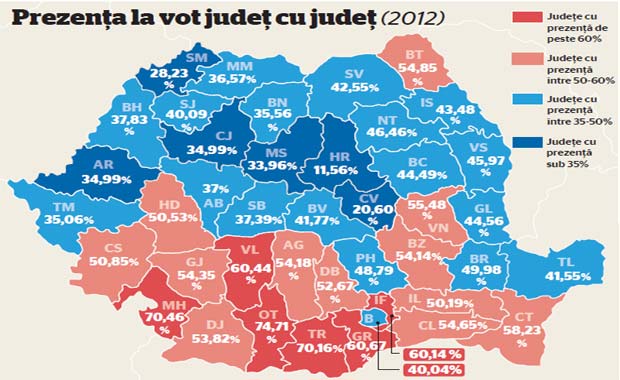
The above image is from Adevarul and struck me as incredibly significant. The blue counties are all those who had less than a 50% turn out and the orange/red ones are those with a higher than 50% turnout. Clearly the red ones seem to indicate a pro-USL (or anti-Basescu) stance while the blue ones are people who boycotted the elections for a variety of reasons.
There are however some very interesting anomalies here, even assuming these figures are true (there may be some fraud proven especially in Olt with such a high turnout compared to the June elections, etc). Adevarul is talking about “north and south” because most blue counties are in the north and most red ones are in the south. But I think there’s something very odd going on here.
To begin with, Bucharest is a tiny spot of blue in a sea of red. How can this be? Bucharest isn’t just the capital and largest city in Romania but also where almost half of all urban dwellers live. So why are they voting so much differently than all of their more rural neighbors?
Sorin Oprescu was re-elected as the mayor of Bucharest in June. Technically he’s an independent (no political party) but he’s a former PSD member and the USL did not run a candidate to oppose him.
In all of the other mayoral races (for the different sectors) in Bucharest, every single contest was won by a USL candidate. In some cases, they had a commanding lead anyway but other races were quite close. Long story short, every mayor in Bucharest is a USL member. So why is Bucharest in blue on this map?
Notice anything else? Iasi, another large city, also with a USL mayor (who was easily re-elected) is also in a blue county. Cluj-Napoca and Timisoara, also blue. In fact, of the top 10 biggest cities in Romania, all of them except two are in blue counties.
Bucharest – Blue
Cluj – Blue
Timisoara – Blue
Iasi – Blue
Constanta – Red
Craiova – Red
Galati – Blue
Brasov – Blue
Ploiesti – Blue
Oradea – Blue
Now I have no way of seeing the breakdown between how cities votes, only the sum total per each county. But isn’t it a little weird that the top 10 biggest cities in Romania are almost universally blue? And Craiova, in Dolj county, is only just barely over the 50% line despite huge wins by the USL in June (including the mayor of Craiova).
This is despite the fact that a lot of these cities are run by USL mayors and/or the county government (such as in Cluj) is run by the USL. How did the USL win so many votes in all of these places in June and be unable to get their people to turn out over the 50% threshold just 5 weeks later?
Meanwhile the reddest counties are all extremely rural and have no large cities. The entire population of Teleorman (the reddest county) could fit inside the Cluj-Napoca city limits without a problem and their capital “city” has less than 50,000 people.
Why did the urban counties vote in fewer numbers while the agricultural counties of the south turn out in such high numbers? I don’t really know. I don’t know if it’s because it was easier to practice voter fraud in rural settings with fewer watchful eyes or it is because these rural farming people are angrier with Basescu or because they have less access to the internet, newspapers and a wider variety of news sources or some kind of combination of all of the above or perhaps something else entirely. I just don’t know.
It really does reinforce my original belief that a lot of people hate Traian Basescu for personal, not political reasons. He’s an urbane man who speaks clearly and decisively and over the years has been seen mingling with the elite in Europe, including Angela Merkel (actively derided by the USL in the past 3 weeks). That kind of thing doesn’t tend to sit well when you’re toiling in the hot fields and loading up melons to sell in the big city to fancy pants urban dwellers with their smart phones and 100 channels on the TV.
Who knows? Maybe I’m wrong. Maybe these sunburned sodbusters retire to their huts after a long hard day and crack open a copy of Alcibiades and remember how Socrates warned about the many pitfalls of entering into politics and their record high turnout at the polls two days ago was the result of a comprehensive analysis of the issues at stake.
I have been wrong before, after all :)
 All Things Romania
My advice would be to change your friends, there are many educated people in Romania. As for me I have read Plato and Aristotel. The reason I have not read Socrates is because he actually never wrote anything. LOL
LikeLike
but you could spell the name of the philosopher correctly, if you actually read his works :)
LikeLike
Bine, prietene, numele lor se scriu corect astfel: Platon si Aristoteles. :-))) I-am citit in romana, nu in engleza (in caz ca n-ai aflat inca, nu erau anglo-saxoni).
LikeLike
iar eu care credeam ca se scrie Πλάτων si Ἀριστοτέλης :))
LikeLike
:-))) M-ai batut la faza asta, recunosc. :-))
LikeLike
They are same name written with corresponding letters from 2 different alphabets.
What was the competition about?
LikeLike
In the rural area people are easier to manipulate, if you give them 1 kg of sugar or wheat flour they vote what you tell them to vote. They lack information and many times they know there are some elections being held, but they don’t know what the current election is about. Usually the mayor or the local priest literally show them where to put the stamp.
The south part of the Romania is Câmpia Română, a land with fertile soil that is cultivated with cereals and sunflower (used to make sunflower seed oil). It’s understandable they are on the red map.
On the other hand, the north side on Romania has not so many crops as the south side, but has more industry and is more interested on how the Romanian economy survives. If you look at the map of important Universities in Romania you’ll notice that in the south part of the country there are virtually none. Timişoara, Iaşi, Cluj, Sibiu are all in the blue area. The only exception is Bucharest – although it is located in the red area, it is the capital, and that makes for urban attitude.
LikeLike
The 50% participation ‘cvorum’ for a referendum has (so was told and went off to investigate to make sure) existed in the Romanian Constitution LONG before 16th July. If you look at this link: http://www.facebook.com/photo.php?fbid=399690436756684&set=p.399690436756684&type=1&theater you can see that the Venice Commission noted Romania as ‘50% participation for a referendum’ even back in 2005.
To my mind, because VP already tried to change this a few days before the 29th July and failed and because not only has it been a Romanian law for at least several years (don’t know since when – couldn’t find that out though I did search) but it’s also EU law too, he will be unable to do much about it without a whole load of bricks coming down on him from the EU. It breaks EU law, in fact, and thus would be a reason to kick Romania right out of the ‘club’. If he cares about that, he won’t do it.
Your suggestion about the consensus I think is far more likely, especially since VP replaced two chiefs in the INS and statistic bureau so recently. It’s pretty clever, really, much as I loathe the thought that he could have found a solution to his ‘problem’.
Indeed – very strange – rural red and urban blue. Yes, probably it’s easier to manipulate in the countryside than in cities – some people will do anything for a free mobile phone, or some firewood for winter (the ruse for mayor-votes in June). I heard tales of how priests were telling people what to vote and that’s nothing new in the countryside. Whether it happens in cities too, I couldn’t say but in the country I have heard it – both for presidential voting and for local votes for mayor. I’d dearly like to know if there are other reasons for the blue/red in the areas noted above apart from supposition.
I’d also like to know what percentage of the population stayed home in support of the boycott, but that we can never know.
And, yes, jos cenzura, I too know a lot of Romanians who have read Shakespeare and Plato. Socrates, can’t say I have but neither have I since Classical Civ classes for A’Level decades ago! I also know many Romanians who love the Brontes, Jane Austin, Dickens and Woolf and can quote Shelley, Wordsworth and Keats better than any Brit. Under communism having such books were considered rare treasures and those I know who read them (and continue to do so), relished every word.
LikeLike
Dude, read the Constitution and tell me where I can find any mention of a percentage. Any place. The Romanian Constitution is, I am ashamed to say, a copy-paste piece of shit with rambling and contradictory articles, but if you tell me where the 50%+1 rule is mentioned, I will put ashes on my head and apologize to you and the 4 ignorant tapeworms who gave this comment a like. :)) cheers!
(Out of curiosity, during this whole debacle, I read the Romanian Constitution and my first instinct was to laugh, the second one was to throw up, and the third one was to burn it and put the video on youtube).
And I do appreciate the fact that you found well-read Romanians; I assume they are not vocal about their intellectual interests, nor do they wear scarves in mid-summer and hang out with Apple paraphernalia and a disinterested look in coffeehouses.
LikeLike
Dude, I’m not sure with what type of pseudo-intellectual scarf-wearing Romanians you have been hanging out with, but trust me there are plenty of “mitici” (with stress on the second syllable) who have read (and understood) Plato, Socrates, Shakespeare et al. :)
LikeLike
For what its worth, in our village there seems to be a strong, proactive and organized USL presence. There was clearly propaganda (mostly on market day) against Basescu … but very little presence of the other voice. Given that there are many elderly people in the village … propaganda goes a long way.
LikeLike
I don’t have data to support this, but it seems to me that those blue counties have the biggest number of “capsunari” in the country. I struck me what a priest said:
<>
http://www.romanialibera.ro/actualitate/eveniment/referendum-2012-biserica-romano-catolica-implicata-in-campania-electorala-afla-de-ce-e-suparat-ips-ioan-robu-pe-traian-basescu-271923.html
LikeLike
Unii preoţi au citit constiinciosi integral textul îndemnului, alţii au sărit pasajul care se referă la Traian Băsescu. Au existat şi preoţi care nu au citit îndemnul lui Robu, mai ales în satele din care au plecat mulţi tineri să lucreze în Italia şi Spania. “Nu puteam să-i îndemn pe oameni să meargă la referendum în condiţiile în care copiii credincioşilor noştri şi-au rugat părinţii să nu se prezinte la urne pentru a nu risca să-şi piardă serviciul din străinătate in cazul in care Romania va fi sanctionata de Uniunea Europeana pentru abuzurile antidemocratice comise pana acum si pentru fraude electorale”, ne-a spus un preot dintr-un sat de ceangăi catolici.
LikeLike
Sorry, don’t be offended by my last comment….just wanted to state that we ALL can be wrong at times ! Anyway, time will tell, no ?
Still, I regret that you haven’t mentioned VOLTAIRE on your list and Heinrich Heyne, Gustave LeBon, Edward Sure….and there are some other ones worthwhile to open our minds to how humanity acts/re-acts/inter-acts and so on…………….
LikeLike
First let me say that your anecdote with the watermelon farmers is perfectly fit with the southern counties, with DJ, OT, TR and IL providing most of the watermelons eaten by the entire country :D
But I think it’s really suspicious how in Teleorman there was 70% presence. Probably the mayors went out of their way to bring people to vote.
LikeLike
Appreciate FULLY your last line……….BRAVO !:-)
LikeLike